Managing critical control points is key to GMP compliance. While batch records, deviations, and lab workflows are digitized, labelling often remains manual.
Labels define product identity, batch status, testing stage, storage, and market authorization. Errors or poor traceability can lead to GMP non-compliance, deviations, delays, and recalls.
During routine operations, this manual setup quietly introduces risk:
- Incorrect or outdated label templates are accidentally used
- Handwritten data creates ambiguity
- Label reconciliation delays batch release
- Audit preparation requires time-consuming manual reconstruction
What appears to be a minor operational gap could become a critical compliance exposure. Therefore, to fill the compliance gaps and reduce manual oversight, electronic and digital labelling systems are becoming a cornerstone of digital GMP transformation.
What Are Digital Labels?
Regulators expect labelling controls to align with the same standards of data integrity applied to batch records and laboratory systems. However, traditional setup still relies heavily on paper labels, manual stamps, and spreadsheet tracking, methods that are difficult to defend during inspections.
Digital labels are generated and governed electronically using validated data sources. They eliminate the risks associated with static paper templates and manual data entry.
Leading manufacturers are adopting GMP labelling practices that provide:
- Centralized control of label templates and formats
- Role-based access and electronic approvals
- Automated population of batch, material, and market data
- Complete electronic audit trails for every GMP event
Benefits of E-Labelling in the Pharmaceutical Industry
E-labelling transforms labelling into a system-controlled GMP activity with measurable impact. The advantage is not just efficiency, it is confidence.
Key characteristics of digital smart labels for pharma include:
- Data-driven label creation
- Controlled versioning and approval history
- Time-stamped, user-attributed actions
- Seamless integration with ERP, LIMS, MES, and QMS
Digital labelling enables better tracking and tracing of pharmaceutical products throughout the supply chain. This can lead to cost savings by reducing the risk of counterfeit products, minimizing product loss or expiration, and optimizing inventory management.
Compliance Benefits
- Reduced labelling deviations and mix-ups
- Stronger ALCOA+ data integrity adherence
- Faster investigation and audit response
- Improved inspection outcomes
Operational Benefits
- Shorter batch release cycles
- Reduced rework and label waste
- Better coordination between QA, manufacturing, and supply chain
Electronic labelling platforms are designed to deliver these benefits while fitting within existing validation and compliance frameworks.
CaliberDigilabel for Smart and Compliant Labelling
Replacing paper labels with digital GMP labels allows for consistency, control, and instant retrievability.
CaliberDigiLabel enables automated labelling and stamping for compliance, supported by GMP guidelines. It offers immense benefits from global standardization, enabling consistent labelling practices across plants and regions.

It can support:
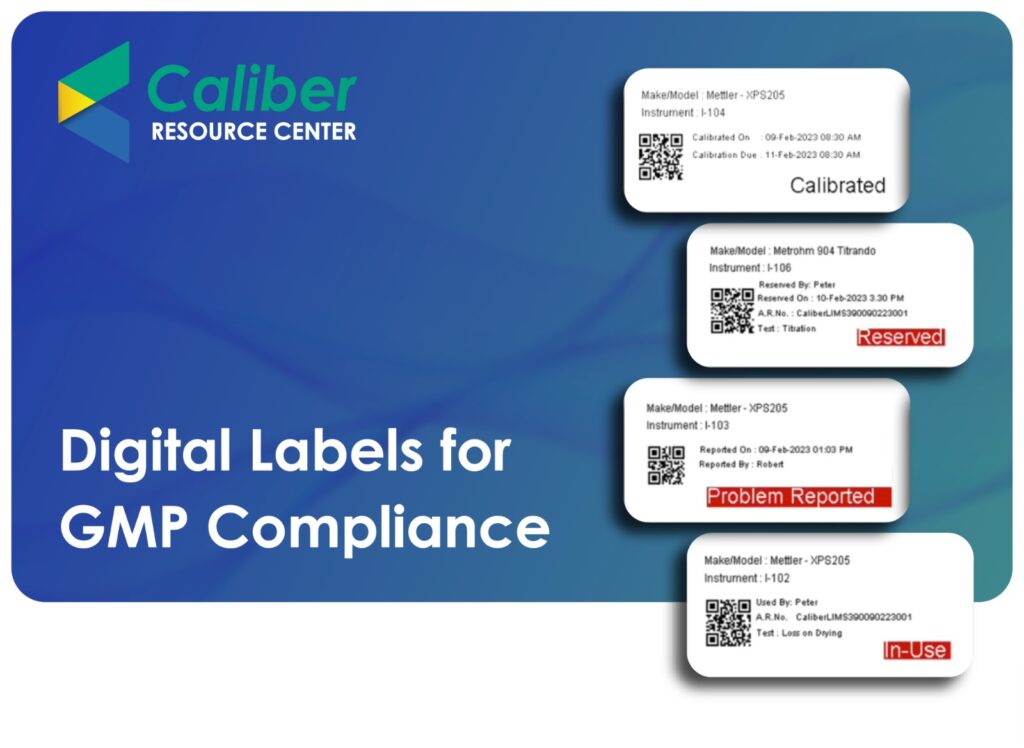
- Sample identification and tracking
- Stability and retain sample control
- Test status visibility
When integrated with LIMS, MES, and other quality systems, CaliberDigiLabel further strengthens data integrity while reducing manual workload at large.
Caliber offers phased implementation, risk-based validation, and close QA involvement. This aligns with the Caliber quality suite and with how platforms like CaliberDigilabel can integrate with LIMS and other pharma solutions to improve efficiency, ease of operations, and expected results. Adopting CaliberDigiLabel as a trusted digital labelling solution will exemplify organizational efforts and support GMP excellence, quietly, reliably, and by design.
To know more how CaliberDigilabel can help enhance GMP compliance at your pharma facility, click here.