

The Bottleneck in an Otherwise Automated World
Injectables manufacturing has seen significant automation over the last two decades, from high-speed filling lines and isolators to automated leak testing and serialization. Yet one critical step continues to lag: visual inspection. Visual inspection plays a decisive role in patient safety.
Act as the last line of defense, against particulate contamination, cosmetic defects, container closure issues, and fill-level anomalies in injectable products. Regulatory expectations across FDA, EU GMP, and major pharma companies continue to emphasize its importance, making inspection outcomes directly tied to batch disposition and product release.
Despite advances in inspection hardware, manual processes remain deeply embedded in how inspection is executed, recorded, and reviewed. This creates a hidden bottleneck – one that slows batch release, introduces compliance risk, and limits real-time quality visibility.
The Limitations of Manual Vial Inspection
Visual Inspection Still Relies on Manual Work in Many Plants
Manual visual inspection isn’t the challenge; it’s the lack of structured support around it. Inspectors often struggle to manage workload, define and apply AQL consistently, and accurately collate and document results within paper-based systems.
This creates unnecessary cognitive load in an already high-intensity process, increasing the risk of inconsistencies and inefficiencies.
Digital systems don’t replace manual inspection, they strengthen it. By acting as a second set of eyes and hands, they support inspectors with better workload management, guided workflows, and reliable data capture, enabling more consistent and confident decision-making.
Operational and Compliance Challenges of Manual Inspection
Where inspection workflows remain manual or semi-digital, several limitations persist:
- Paper-based logs and manual counting, often supported by spreadsheets for AQL calculations
- High dependency on human performance, making outcomes vulnerable to fatigue, distraction, and inconsistency
- Delayed visibility, with quality teams receiving inspection data only after sessions are completed and reviewed
- Batch release delays, as reconciliation, verification, and documentation consume significant QA effort
- Compliance risk, including incomplete records, transcription errors, and challenges during audits
What appears to be a familiar, “accepted” process often becomes a silent constraint on efficiency and compliance.
Introducing CaliberVIse: Transforming Visual Inspection into a Digital Process
CaliberVIse reimagines visual inspection, not by replacing inspectors or hardware, but by digitalizing the inspection workflow itself. Brings the entire visual inspection lifecycle onto a single, digitally governed platform, accelerating inspection processes while upholding GMP and data integrity principles.

With real-time controls, standardized workflows, and configurable inspection parameters, it embeds accountability and consistency into every inspection session, supporting a controlled transition toward better inspection practices.
At its core, CaliberVIse converts inspection sessions from paper-driven activities into fully digital, controlled, and traceable processes.
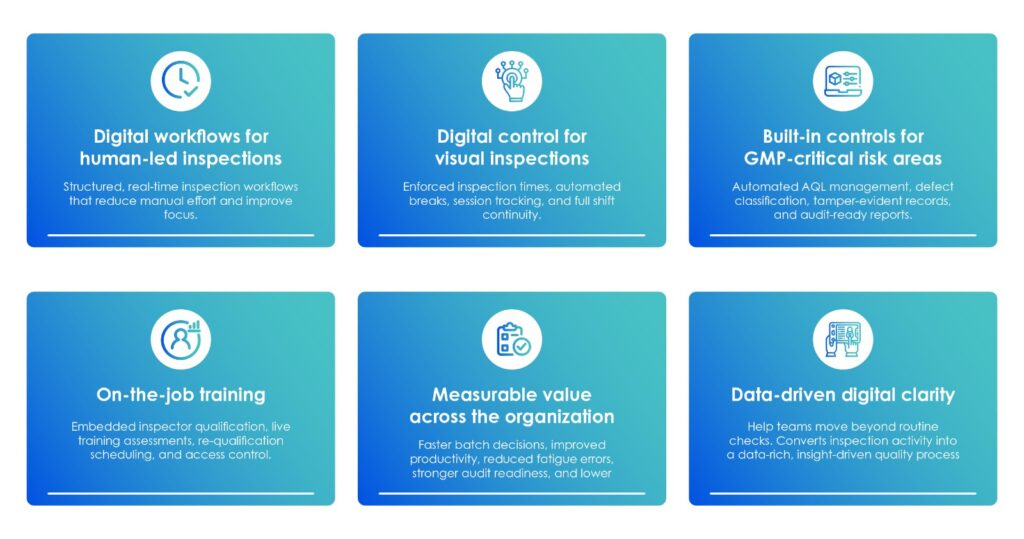
What CaliberVIse enables?
- Fully digital inspection sessions with system-enforced workflows
- Automated unit counting and real-time
- AQL calculations Structured defect logging with timestamps and inspector attribution
By digitalizing every inspection step, CaliberVIse transforms visual inspection from a manual, error-prone task into a compliant, insight-driven quality function.
Conclusion: From Manual Checks to Intelligent Inspection
While inspection hardware continues to evolve, complete digital transformation of visual inspection workflows, including AQL logging, session traceability, paper-free enforcement, analytics, and real-time compliance, is not yet standard practice across the industry.
This represents both a challenge and an opportunity. Visual inspection must be treated not as a necessary burden, but as a strategic quality function. CaliberVIse provides the foundation for this shift, enabling data-driven quality decisions, faster releases, and stronger compliance without disrupting existing inspection methods. Discover more about the features and functionalities of CaliberVISE in Pharma environment, click here.