
In pharmaceutical manufacturing, a deviation tells you where a quality problem became visible. It rarely tells you where it began.
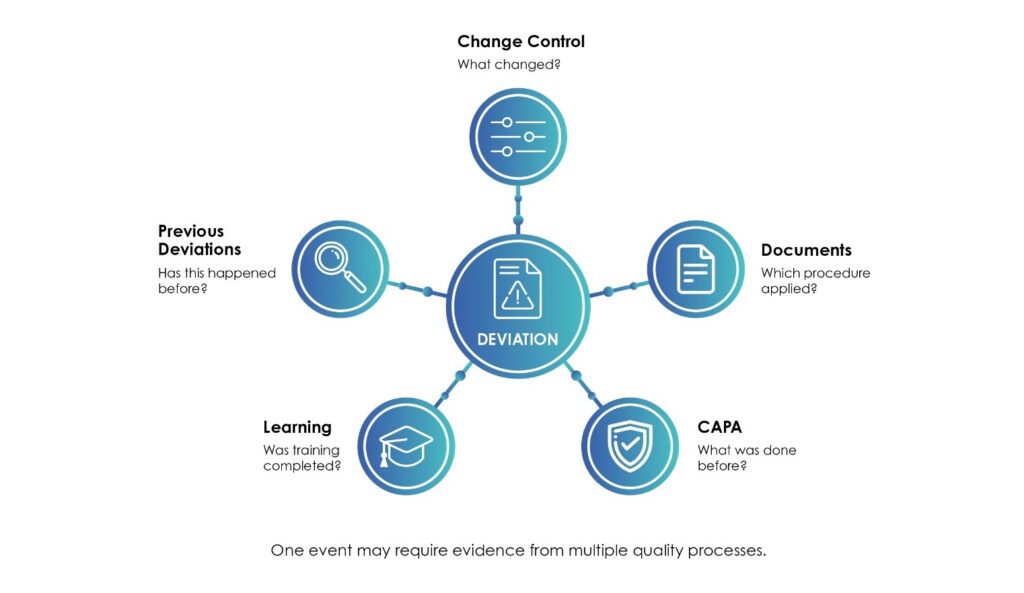
An unexpected result appears, a process moves outside its expected scope, or an operator notices something unusual. The deviation is opened and the investigation begins. The first facts establish what happened, but the investigation soon extends further. What changed before the event? Which procedure was in effect? Was the required training completed? Had a similar deviation occurred before? Was a related corrective and preventive action (CAPA) already implemented?
The answers often exist across several quality processes. The challenge is bringing the relevant evidence into the investigation when it matters.
What Evidence Should a Deviation Investigation Consider?
Depending on the event, investigators review change controls, documents, training records, previous deviations and CAPAs to understand what changed, which requirements applied and whether the issue has occurred before.
Each source provides a different part of the picture. The deviation describes the event. Change controls show what changed before it. Controlled documents establish the approved procedure in effect at the time. Training records show whether required learning was completed. Previous deviations provide a record of similar events, while related CAPAs show how earlier issues were addressed.
Taken together, these records give investigators the context to assess the event more fully.
Context Matters in Root Cause Analysis
Investigators do more than locate records. They determine which records have a bearing on the event and what those relationships reveal.
A routine process change, for example, deserves closer attention when a similar deviation appears across several batches. A completed training record provides one piece of evidence; the timing of a procedure revision adds another. When a related event occurs again, an earlier CAPA warrants closer review.
When information sits across different systems and records, investigators spend part of the investigation locating it, establishing its relevance and bringing it together. Understanding those relationships helps investigators assess the event in context.
Root cause analysis depends on the evidence considered during the investigation. The investigator makes the judgement while the surrounding evidence gives that judgement its foundation.
What Should Investigators Look for Beyond the Deviation Record?
The evidence relevant to an investigation varies with the event. Several areas commonly provide useful context.
Recent changes: Did anything change in the process, procedure, equipment or approved way of working before the event?
Applicable documents: Which approved procedure was in effect when the event occurred?
Training history: Was the required training completed against the applicable process or procedure?
Previous deviations: Has the same or a similar event occurred before, and what did the earlier investigation conclude?
Previous CAPAs: Was action already taken for a related issue, and does the current event warrant another look at its effectiveness?
The purpose is not to review every available record. It is to follow the evidence far enough to understand the event and make a sound quality decision.
What Does Inspection Readiness Require from An Investigation?
During an inspection, finding a deviation record quickly is useful. Explaining how the investigation reached its conclusion matters more.
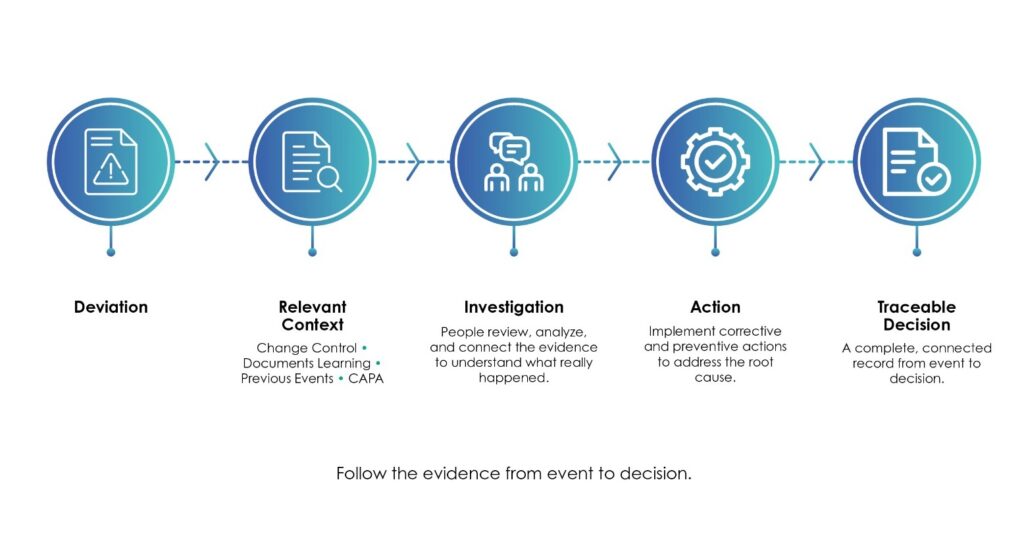
A manufacturer may be asked to explain what happened, how the event was investigated, what evidence was considered, why a root cause was identified, what action followed and whether that action proved effective. Those answers often draw on information from more than one quality process.
When supporting information is easier to follow, teams have a clearer trail from event to evidence, decision and action. Inspection readiness therefore depends not only on having the right records, but also on being able to explain the reasoning behind the quality decision.
How Can an Integrated QMS Support Deviation Investigations?
The way quality work crosses these processes also explains the thinking behind epiq by Caliber.
epiq brings Quality Management, Document Management and Learning Management together through Assure-IQ, Docs-IQ and Learn-IQ within one enterprise platform. It provides a common user experience, with centralized administration, security, user and role management across these areas.
These processes are closely linked in day-to-day quality work. A process change, a document revision and the training that follows can all become relevant when a later quality event is investigated.
epiq provides the platform for managing these connected quality processes. The investigation itself remains a matter of evaluating evidence, applying quality judgement and reaching a defensible conclusion.
See Beyond the Deviation
Much of the evidence surrounding a deviation already exists within day-to-day quality processes. Its value becomes clearer when investigators can follow that evidence as the investigation develops.
A deviation may be where the investigation starts. It should not define how far the investigator looks.
See the wider quality context with epiq
Explore how epiq by Caliber brings Quality Management, Document Management and Learning Management together in one enterprise platform.